Speculum Redesign
Summary
Current vaginal speculums in the medical space cause significant patient discomfort, anxiety, and loss of agency during gynecological examinations due to an outdated design that fails to prioritize patient experience, creating barriers to routine gynecological care and contributing to medical avoidance. I wanted to understand the history of the design, why it remains unchanged, what patients actually experience, and how it could be redesigned with users at the center.
Project type
Industrial design
Role
Designer
Year
2026

My approach
In order to truly understand the why behind the design I had to understand the female body both medically and through user research.
As an independent research project, I conducted a comprehensive analysis of secondary sources including peer-reviewed medical journals, clinical news articles, and 44 patient testimonials from online forums (2014-2025). To support my research, I conducted an informational interview with an OBGYN Medical Director, 5 years post-residency (University of Chicago), LA County Hospital. This multi-source approach revealed consistent patterns in patient experience that directly informed my design requirements.
Key Research Findings
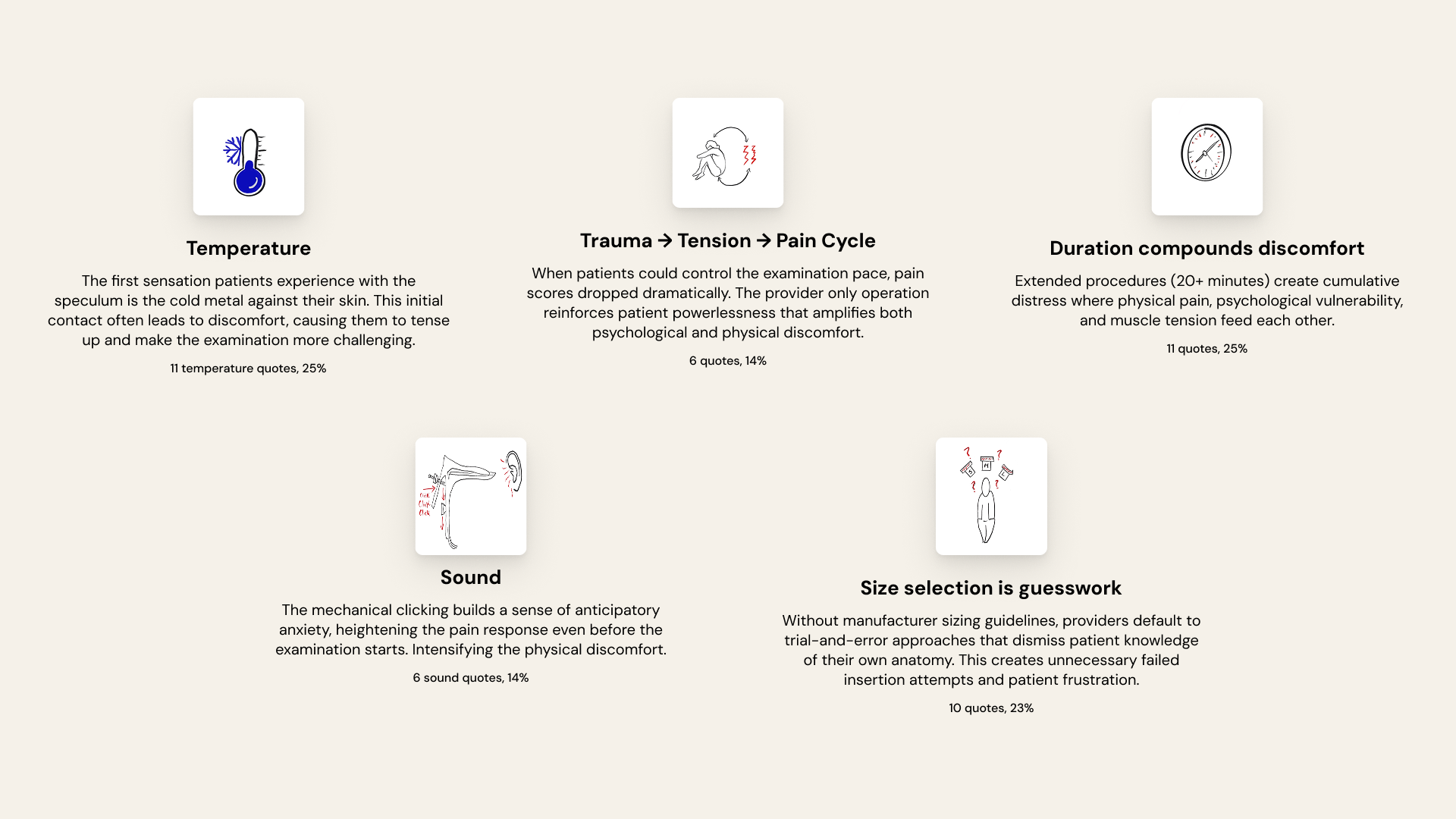
As this was an independent project, I leaned on secondary research from peer-reviewed medical journals, news articles, and 44 quotes from patient forums (2014-2025). Below you’ll find the top themes stemming from my research. I later used this information to formulate my design requirements for the redesign.
Current in-market speculums
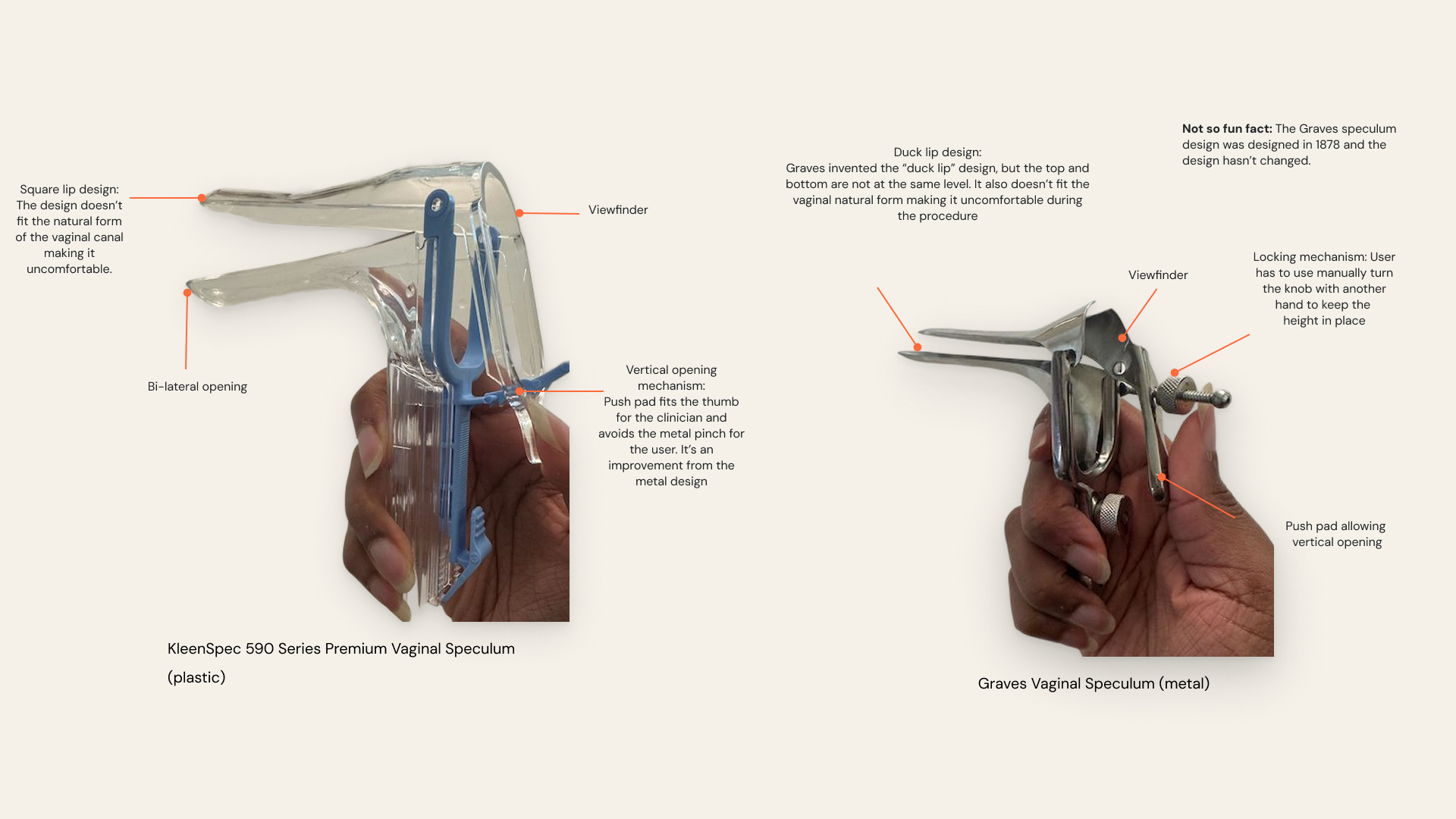
Before starting my redesign, it was important that I analyze existing speculums on the market. I analyzed them to understand what is working and not working about the design, why they chose the material, the ergonomics for the doctor, and reusability.
Clinical Insights
To support my research, I did an informational interview with a gynecologist to understand the clinicians experience. I conducted an informational interview with an OBGYN Medical Director, 5 years post-residency (University of Chicago), LA County Hospital.
The lateral vaginal wall tissue can block the view of the cervix
“If you have somebody who has a lot of vaginal tissue... the tissue comes and falls down in the way of the sides, and so if you had something to kind of like push that apart, you may not need as big [of a speculum]”
Sharp edges of the tool cause discomfort
“That part [metal screw/knob] can kind of, if you have a heavier person, can dig into the thigh. So I often have to put like a gauze behind that if I'm doing a longer procedure to pad it."
Structural materials are necessary
"One of the main issues with the speculum is the rigidity of it... it's very uncomfortable because you need a lot of rigidity to open the vaginal walls, but that's the part that's most uncomfortable.”
Past sexual trauma influences patient experience
What happens with sexual trauma is that people have... a psychosomatic like real response to being touched in sensitive areas, so they'll... experience it as extremely painful because of the previous trauma..."
Brainstorming
Prototyping the petals & handles
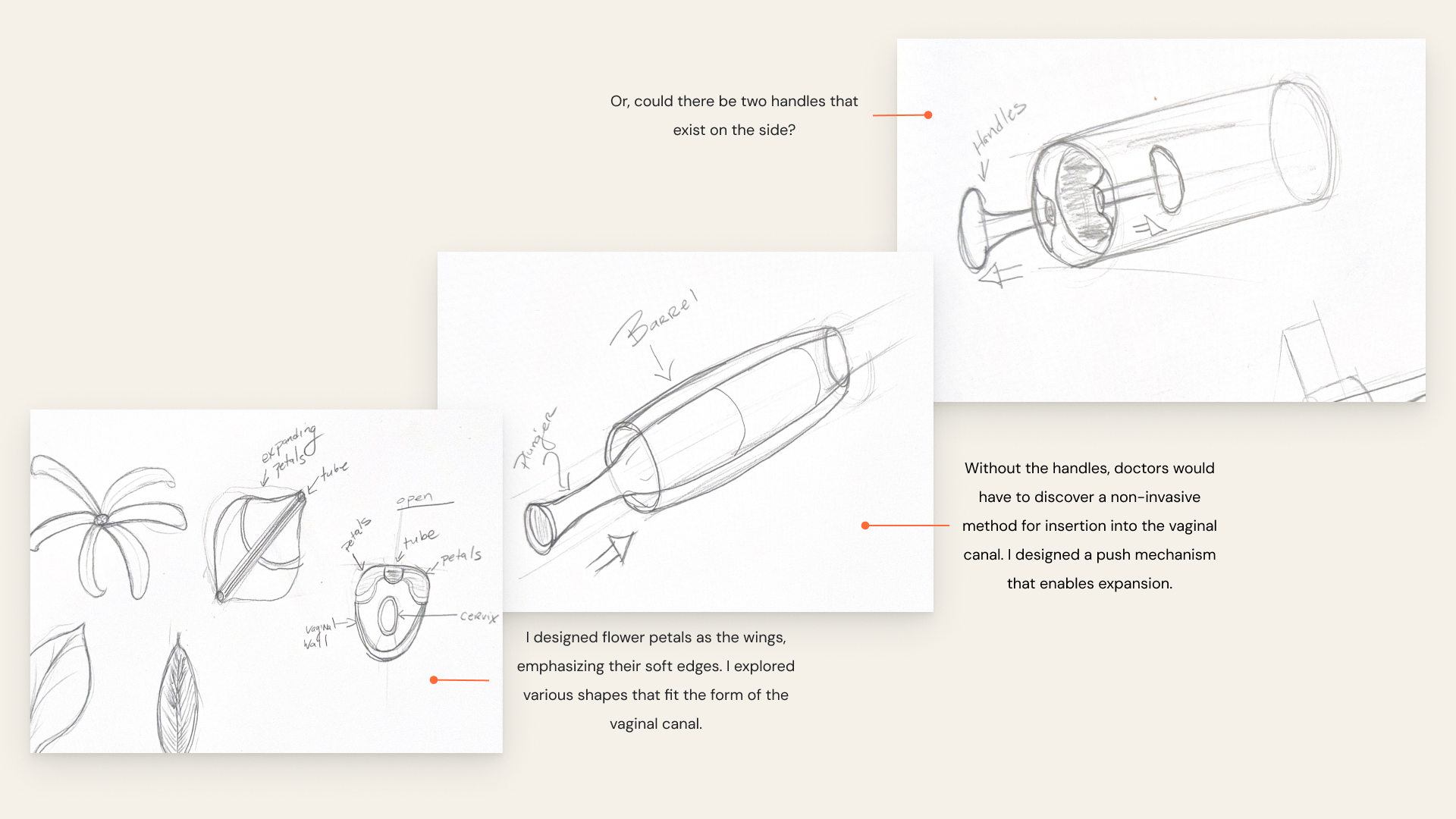
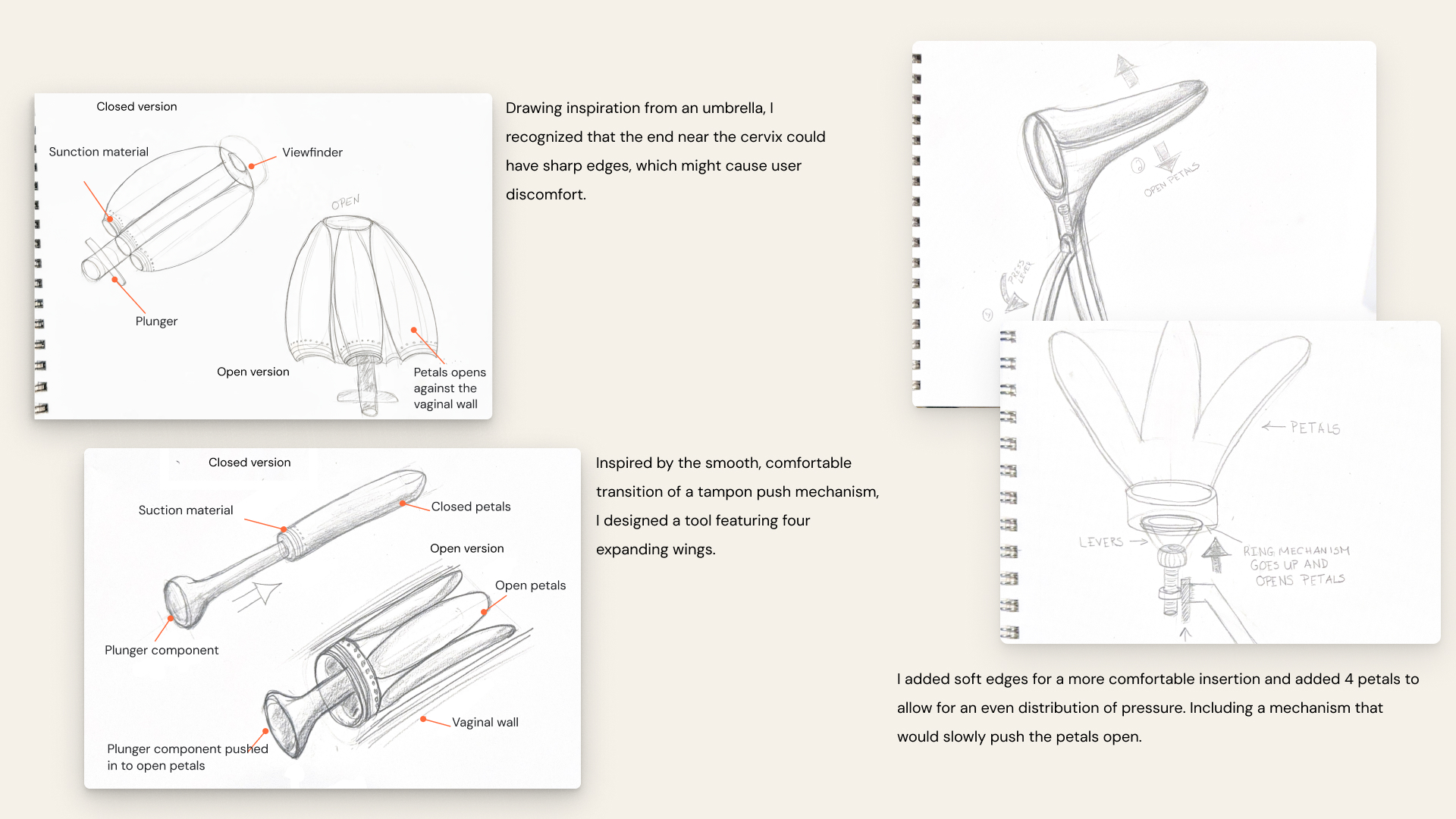
I transitioned to cardboard prototyping to investigate the shape and size of the petals. I focused on overlapping the petals when closed, making it larger and more supportive for the user when expanded. Based on OBGYN’s concern about lateral tissue blocking views, I designed the four-petal system to provide circumferential support rather than bilateral compression.
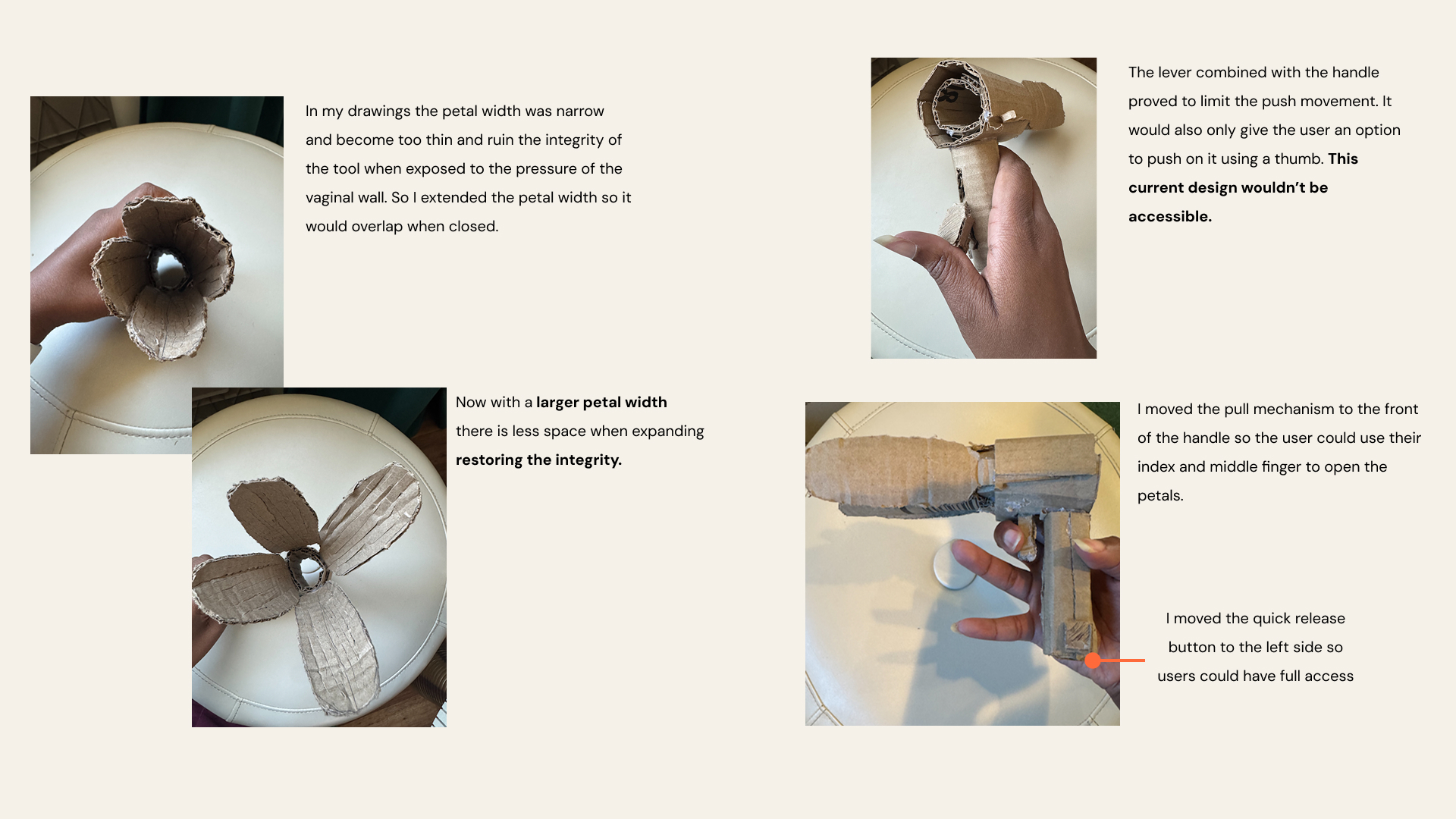
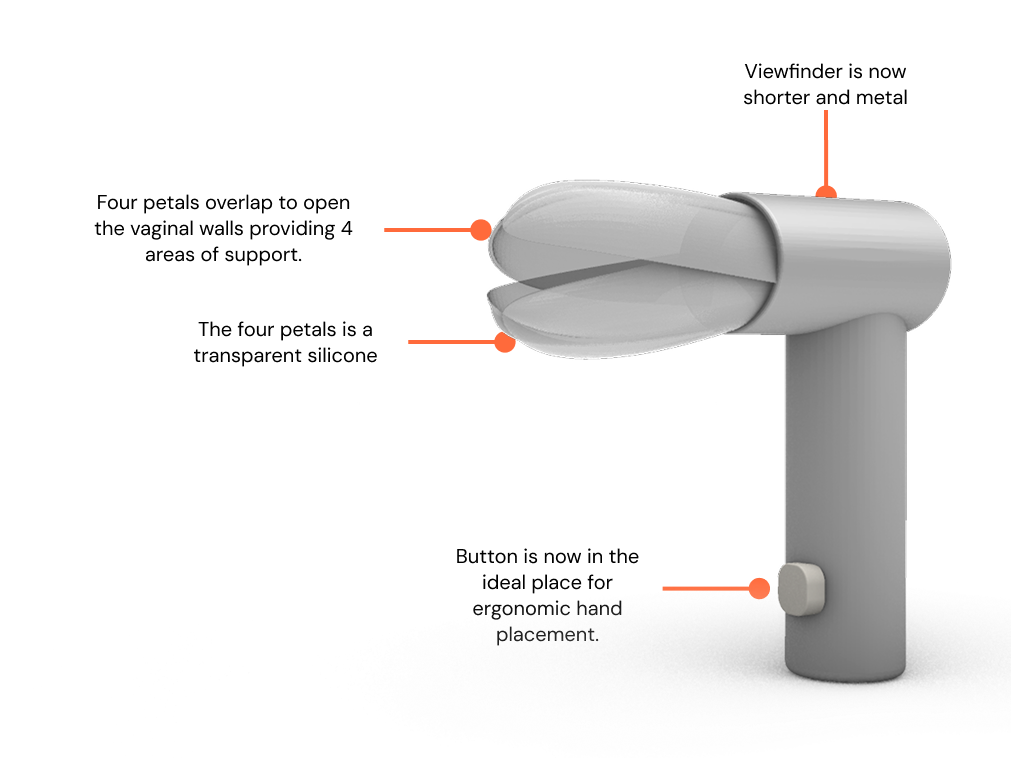
While working on the CAD model, I implemented important design changes based on feedback from my professor. I repositioned the button to the front for a better ergonomic feel. I relocated the mechanism that opens/closes the petals to be integrated within the handle, allowing it to be controlled by the button.
Final Product: The Petal Speculum
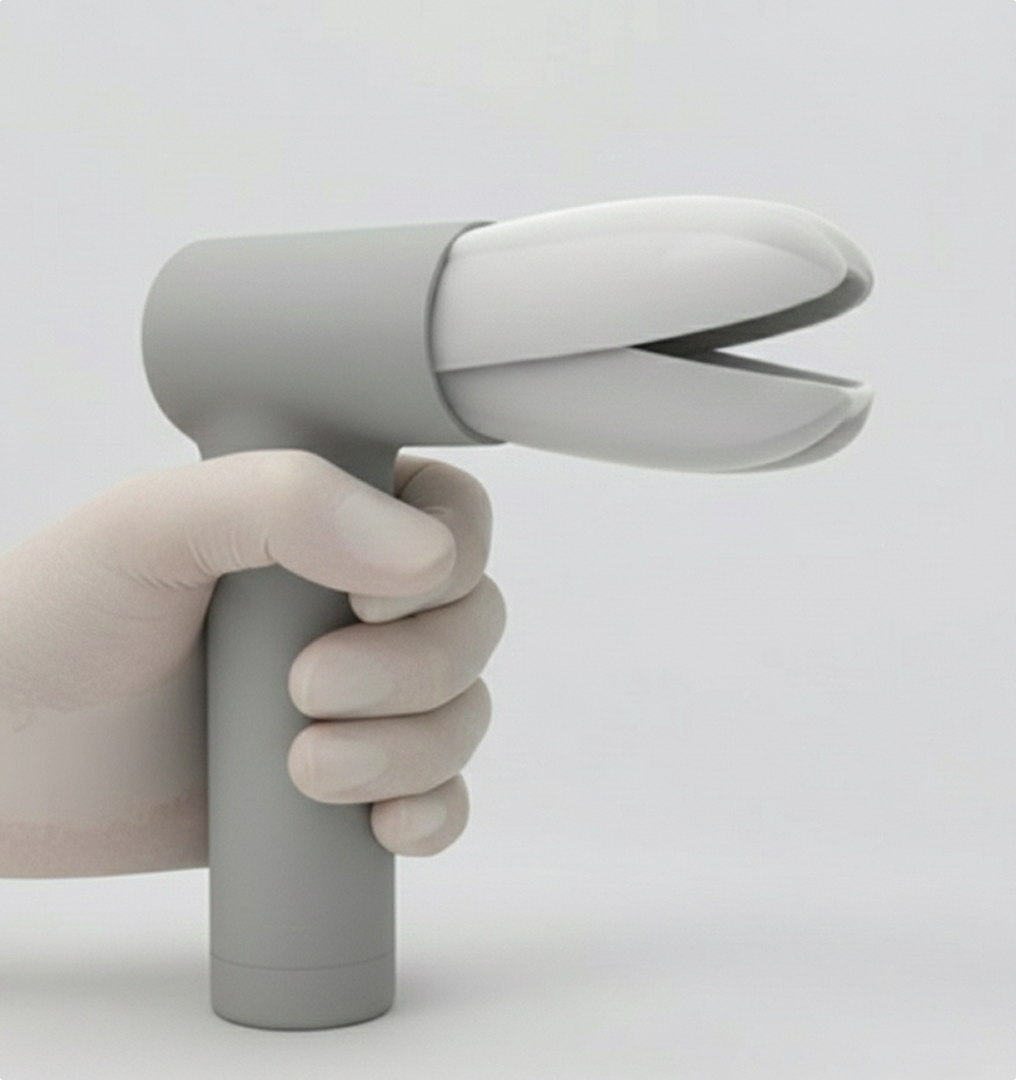
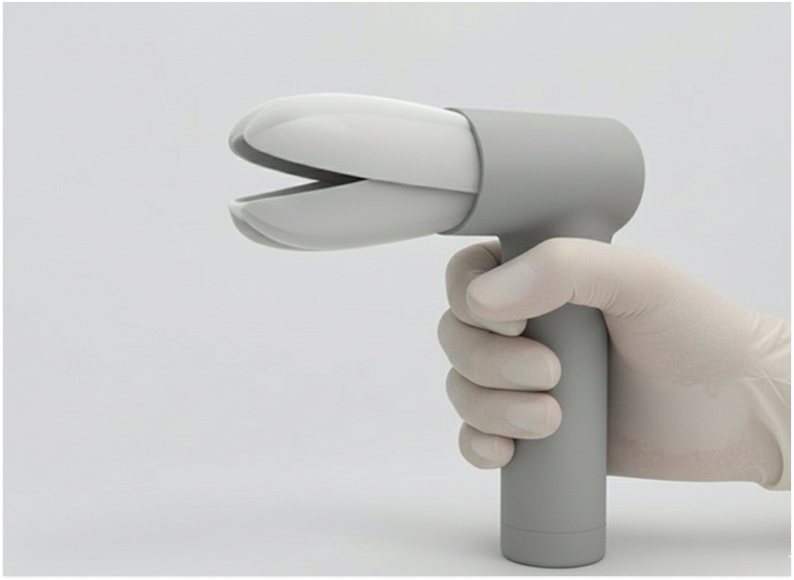
My redesigned speculum achieves the main user centered goals with an ergonomic handle, sound reduction, quick release button, and pressure distribution with 4 petals.
Measurements & Materials
Four petals: Medical-grade silicone, 22mm W, 40mm L
View-finder: Metal, 58mm W, 38mm L
Handle: Metal, 33mm W, 100mm L
If I had additional resources I would focus on several areas:
Size adaptability would require further research and testing with physical prototypes. To understand the temperature it will require testing with various materials.
Designing trauma informed care requires working with doctors and patients to further understand the problem and design a solution. Unfortunately, it is out of scope.


currently studying Industrial Design Engineering at TU Delft
Speculum Redesign
Summary
Current vaginal speculums in the medical space cause significant patient discomfort, anxiety, and loss of agency during gynecological examinations due to an outdated design that fails to prioritize patient experience, creating barriers to routine gynecological care and contributing to medical avoidance. I wanted to understand the history of the design, why it remains unchanged, what patients actually experience, and how it could be redesigned with users at the center.
Project type
Industrial design
Role
Designer
Year
2026

My approach
In order to truly understand the why behind the design I had to understand the female body both medically and through user research.
As an independent research project, I conducted a comprehensive analysis of secondary sources including peer-reviewed medical journals, clinical news articles, and 44 patient testimonials from online forums (2014-2025). To support my research, I conducted an informational interview with an OBGYN Medical Director, 5 years post-residency (University of Chicago), LA County Hospital. This multi-source approach revealed consistent patterns in patient experience that directly informed my design requirements.
Key Research Findings
As this was an independent project, I leaned on secondary research from peer-reviewed medical journals, news articles, and 44 quotes from patient forums (2014-2025). Below you’ll find the top themes stemming from my research. I later used this information to formulate my design requirements for the redesign.
Current in-market speculums
Before starting my redesign, it was important that I analyze existing speculums on the market. I analyzed them to understand what is working and not working about the design, why they chose the material, the ergonomics for the doctor, and reusability.
Clinical Insights
To support my research, I did an informational interview with a gynecologist to understand the clinicians experience. I conducted an informational interview with an OBGYN Medical Director, 5 years post-residency (University of Chicago), LA County Hospital.
The lateral vaginal wall tissue can block the view of the cervix
“If you have somebody who has a lot of vaginal tissue... the tissue comes and falls down in the way of the sides, and so if you had something to kind of like push that apart, you may not need as big [of a speculum]”
Sharp edges of the tool cause discomfort
“That part [metal screw/knob] can kind of, if you have a heavier person, can dig into the thigh. So I often have to put like a gauze behind that if I'm doing a longer procedure to pad it."
Structural materials are necessary
"One of the main issues with the speculum is the rigidity of it... it's very uncomfortable because you need a lot of rigidity to open the vaginal walls, but that's the part that's most uncomfortable.”
Past sexual trauma influences patient experience
What happens with sexual trauma is that people have... a psychosomatic like real response to being touched in sensitive areas, so they'll... experience it as extremely painful because of the previous trauma..."
Brainstorming
Prototyping the petals & handles
I transitioned to cardboard prototyping to investigate the shape and size of the petals. I focused on overlapping the petals when closed, making it larger and more supportive for the user when expanded. Based on OBGYN’s concern about lateral tissue blocking views, I designed the four-petal system to provide circumferential support rather than bilateral compression.
While working on the CAD model, I implemented important design changes based on feedback from my professor. I repositioned the button to the front for a better ergonomic feel. I relocated the mechanism that opens/closes the petals to be integrated within the handle, allowing it to be controlled by the button.
Final Product: The Petal Speculum
My redesigned speculum achieves the main user centered goals with an ergonomic handle, sound reduction, quick release button, and pressure distribution with 4 petals.
Measurements & Materials
Four petals: Medical-grade silicone, 22mm W, 40mm L
View-finder: Metal, 58mm W, 38mm L
Handle: Metal, 33mm W, 100mm L
If I had additional resources I would focus on several areas:
Size adaptability would require further research and testing with physical prototypes. To understand the temperature it will require testing with various materials.
Designing trauma informed care requires working with doctors and patients to further understand the problem and design a solution. Unfortunately, it is out of scope.
currently studying Industrial Design Engineering at TU Delft
Speculum Redesign
Summary
Current vaginal speculums in the medical space cause significant patient discomfort, anxiety, and loss of agency during gynecological examinations due to an outdated design that fails to prioritize patient experience, creating barriers to routine gynecological care and contributing to medical avoidance. I wanted to understand the history of the design, why it remains unchanged, what patients actually experience, and how it could be redesigned with users at the center.
Project type
Industrial design
Role
Designer
Year
2026

My approach
In order to truly understand the why behind the design I had to understand the female body both medically and through user research.
As an independent research project, I conducted a comprehensive analysis of secondary sources including peer-reviewed medical journals, clinical news articles, and 44 patient testimonials from online forums (2014-2025). To support my research, I conducted an informational interview with an OBGYN Medical Director, 5 years post-residency (University of Chicago), LA County Hospital. This multi-source approach revealed consistent patterns in patient experience that directly informed my design requirements.
Key Research Findings
As this was an independent project, I leaned on secondary research from peer-reviewed medical journals, news articles, and 44 quotes from patient forums (2014-2025). Below you’ll find the top themes stemming from my research. I later used this information to formulate my design requirements for the redesign.
Current in-market speculums
Before starting my redesign, it was important that I analyze existing speculums on the market. I analyzed them to understand what is working and not working about the design, why they chose the material, the ergonomics for the doctor, and reusability.
Clinical Insights
To support my research, I did an informational interview with a gynecologist to understand the clinicians experience. I conducted an informational interview with an OBGYN Medical Director, 5 years post-residency (University of Chicago), LA County Hospital.
The lateral vaginal wall tissue can block the view of the cervix
“If you have somebody who has a lot of vaginal tissue... the tissue comes and falls down in the way of the sides, and so if you had something to kind of like push that apart, you may not need as big [of a speculum]”
Sharp edges of the tool cause discomfort
“That part [metal screw/knob] can kind of, if you have a heavier person, can dig into the thigh. So I often have to put like a gauze behind that if I'm doing a longer procedure to pad it."
Structural materials are necessary
"One of the main issues with the speculum is the rigidity of it... it's very uncomfortable because you need a lot of rigidity to open the vaginal walls, but that's the part that's most uncomfortable.”
Past sexual trauma influences patient experience
What happens with sexual trauma is that people have... a psychosomatic like real response to being touched in sensitive areas, so they'll... experience it as extremely painful because of the previous trauma..."
Brainstorming
Prototyping the petals & handles
I transitioned to cardboard prototyping to investigate the shape and size of the petals. I focused on overlapping the petals when closed, making it larger and more supportive for the user when expanded. Based on OBGYN’s concern about lateral tissue blocking views, I designed the four-petal system to provide circumferential support rather than bilateral compression.
While working on the CAD model, I implemented important design changes based on feedback from my professor. I repositioned the button to the front for a better ergonomic feel. I relocated the mechanism that opens/closes the petals to be integrated within the handle, allowing it to be controlled by the button.
Final Product: The Petal Speculum
My redesigned speculum achieves the main user centered goals with an ergonomic handle, sound reduction, quick release button, and pressure distribution with 4 petals.
Measurements & Materials
Four petals: Medical-grade silicone, 22mm W, 40mm L
View-finder: Metal, 58mm W, 38mm L
Handle: Metal, 33mm W, 100mm L
If I had additional resources I would focus on several areas:
Size adaptability would require further research and testing with physical prototypes. To understand the temperature it will require testing with various materials.
Designing trauma informed care requires working with doctors and patients to further understand the problem and design a solution. Unfortunately, it is out of scope.
currently studying Industrial Design Engineering at TU Delft
Christina Campbell
Work
About
Contact
Speculum Redesign
Summary
Current vaginal speculums in the medical space cause significant patient discomfort, anxiety, and loss of agency during gynecological examinations due to an outdated design that fails to prioritize patient experience, creating barriers to routine gynecological care and contributing to medical avoidance. I wanted to understand the history of the design, why it remains unchanged, what patients actually experience, and how it could be redesigned with users at the center.
Project type
Industrial design
Role
Designer
Year
2026
My approach
In order to truly understand the why behind the design I had to understand the female body both medically and through user research.
As an independent research project, I conducted a comprehensive analysis of secondary sources including peer-reviewed medical journals, clinical news articles, and 44 patient testimonials from online forums (2014-2025). To support my research, I conducted an informational interview with an OBGYN Medical Director, 5 years post-residency (University of Chicago), LA County Hospital. This multi-source approach revealed consistent patterns in patient experience that directly informed my design requirements.
Key Research Findings
As this was an independent project, I leaned on secondary research from peer-reviewed medical journals, news articles, and 44 quotes from patient forums (2014-2025). Below you’ll find the top themes stemming from my research. I later used this information to formulate my design requirements for the redesign.
Current in-market speculums
Before starting my redesign, it was important that I analyze existing speculums on the market. I analyzed them to understand what is working and not working about the design, why they chose the material, the ergonomics for the doctor, and reusability.
Clinical Insights
To support my research, I did an informational interview with a gynecologist to understand the clinicians experience. I conducted an informational interview with an OBGYN Medical Director, 5 years post-residency (University of Chicago), LA County Hospital.
The lateral vaginal wall tissue can block the view of the cervix
“If you have somebody who has a lot of vaginal tissue... the tissue comes and falls down in the way of the sides, and so if you had something to kind of like push that apart, you may not need as big [of a speculum]”
Sharp edges of the tool cause discomfort
“That part [metal screw/knob] can kind of, if you have a heavier person, can dig into the thigh. So I often have to put like a gauze behind that if I'm doing a longer procedure to pad it."
Structural materials are necessary
"One of the main issues with the speculum is the rigidity of it... it's very uncomfortable because you need a lot of rigidity to open the vaginal walls, but that's the part that's most uncomfortable.”
Past sexual trauma influences patient experience
What happens with sexual trauma is that people have... a psychosomatic like real response to being touched in sensitive areas, so they'll... experience it as extremely painful because of the previous trauma..."
Brainstorming
Prototyping the petals & handles
I transitioned to cardboard prototyping to investigate the shape and size of the petals. I focused on overlapping the petals when closed, making it larger and more supportive for the user when expanded. Based on OBGYN’s concern about lateral tissue blocking views, I designed the four-petal system to provide circumferential support rather than bilateral compression.
While working on the CAD model, I implemented important design changes based on feedback from my professor. I repositioned the button to the front for a better ergonomic feel. I relocated the mechanism that opens/closes the petals to be integrated within the handle, allowing it to be controlled by the button.
Final Product: The Petal Speculum
My redesigned speculum achieves the main user centered goals with an ergonomic handle, sound reduction, quick release button, and pressure distribution with 4 petals.
Measurements & Materials
Four petals: Medical-grade silicone, 22mm W, 40mm L
View-finder: Metal, 58mm W, 38mm L
Handle: Metal, 33mm W, 100mm L
If I had additional resources I would focus on several areas:
Size adaptability would require further research and testing with physical prototypes. To understand the temperature it will require testing with various materials.
Designing trauma informed care requires working with doctors and patients to further understand the problem and design a solution. Unfortunately, it is out of scope.
currently studying Industrial Design Engineering at TU Delft